 chloedickenson
Last Updated on 8th September 2023
This post contains mentions of a gifted experience with Split Food Tour, please see my disclaimer for more.

Are you heading to Split, Croatia and wanting to learn more about the city’s epic food scene? Check out my extensive review of the incredible Split Food Walking Tour!
Croatia might not be as synonymous with an exciting food scene as other Mediterranean countries such as Italy or Greece, for example, but upon arriving in the coastal city of Split for one month, I was delighted to discover that it’s home to some truly wonderful cuisine, all thanks to the help of Split Food Tour.
Split Food Tour is a company that was only founded in 2022, so it’s a super-new tour provider on the Split food scene and one that I know will be a roaring success for years to come.
If you’re planning a trip to the gorgeous city of Split and you want to experience its wonderful cuisine and learn more about the history of the city as you explore the Old Town, check out my review of Split Food Tour below which includes details of what you can expect on the tour, the best places to eat in Split and which dishes you need to try!
P.S. This Split Food Tour review does contain spoilers about where you’ll visit and what you’ll eat on the tour!
Read more: The Best Restaurants In Split, Croatia For Every Budget
What to expect from a Split Food Tour

When the lovely Emma and Dino behind Split Food Tour invited us on one of their food tours in Split, we had no idea what to expect.
We’d only been on two food tours before, one in Ho Chi Minh City and one in our hometown of York, so our experience of culinary tours was very limited and as Split Food Tour only started operating in early 2022, we weren’t sure how good it would actually be…
Fast-forward four hours later at the end of the tour and I could safely say that it was one of the best excursions we’ve ever been on in our many years of travelling. Our group of five (plus Dino) was the perfect number of people to embark on the tour as it meant that we got to enjoy everyone’s company while dining.
Split Food Tour usually runs tours for groups between 2-10 people, which is the perfect number of people to ensure an intimate, authentic experience. Our tour group was also the last one running for the season, as Split Food Tour intends to operate between May and October each year, so bear that in mind if you’re thinking of coming to Split in the off-season.
One thing that surprised me the most about our food tour in Split was how much we learned along the way. We didn’t expect the tour to include so much in-depth information about the city of Split and the spectacular Diocletian Palace, but this was truly a highlight of the tour.
Dino, our tour guide and co-founder of Split Food Tour, is one of the nicest, most genuine and great guys we’ve ever met on our travels and his knowledge of food and his city seemed to know no bounds. We were also lucky to accidentally bump into his wife Emma at a digital nomad meet-up after the tour, and she is as equally lovely and brilliant!
I don’t want to give too much away in my review of our experience of the Split Food Tour, but I also can’t rave about it enough so if you don’t want to know too much about the food stops you’ll be visiting, look away now!
Split Food Tour – food stops

On the culinary tour in Split, you’ll visit six different stops and try over a dozen different things, from delectable Dalmatian prosciutto to exquisite seafood directly from the Adriatic Sea to palate-cleansing ice cream or sorbet; there are so many wonderful dishes to try on a food tour in Split.
Below, I’ve broken down each stop on the tour to give you more information about the dishes you can expect to eat and the dining environment in which you’ll be enjoying them. So, once again, if you don’t want any spoilers about the Split Food Tour, don’t read the section below!
1. Restaurant Štorija

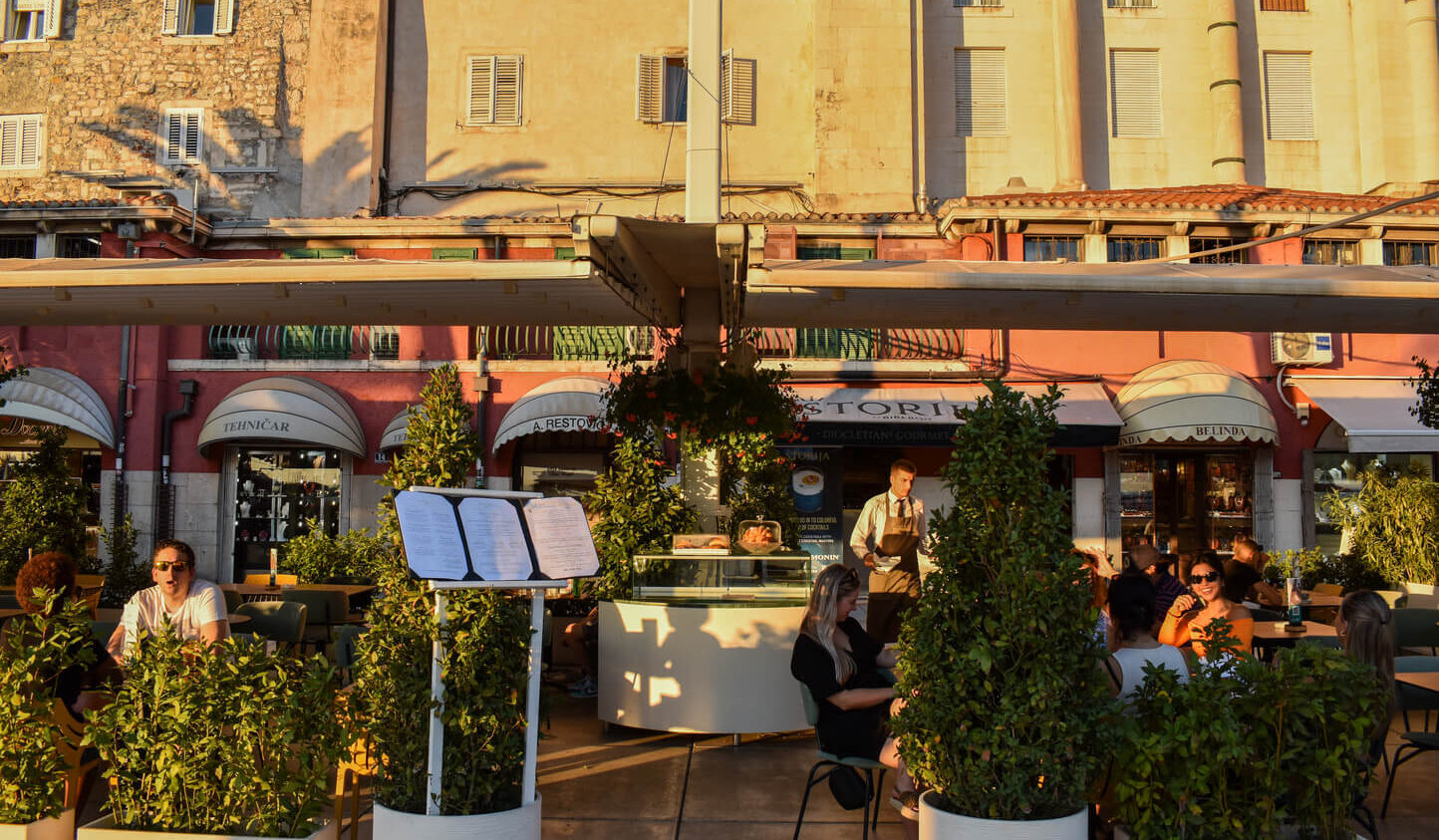
The first stop on your gastro tour in Split is a restaurant called Štorija. Located along Split’s main promenade known as Riva, this little eatery looks like an unassuming al fresco restaurant like any other on the waterfront.
However, upon entering the building of Štorija, you’re greeted with the most stunning restaurant interior, complete with beautiful lighting, elegant yet understated table decor and the most relaxing, charming atmosphere.
Every member of our group audibly gasped when we headed inside and when Dino told us that he and his wife had their wedding reception at Štorija (which is why they chose it as the first stop on the food tour), we all instantly loved it even more.
At Štorija, we enjoyed a delightful Dalmatian Charcuterie board. Complete with cow’s cheese that comes from the island of Pag, two types of prosciutto, a scrumptious fig jam, pickled garlic, mozzarella-stuffed peppers and a side of homemade bread, this was literally the Charcuterie board of my dreams!
Dino also informed us about the origins of many of the ingredients, including the fact that the cow’s cheese is so delicious as the animals on the island of Pag only eat little shrubs that are blown by a chaotic wind. The prosciutto is also so good because it’s much drier than the likes of Italian meat, for example, as it too is blown dry by the crazy Dalmatian wind.
With the first stop being such a roaring success, we couldn’t wait to head to stop number two…
2. Restaurant Leonis


Leonis is the second restaurant that you’ll visit on this culinary tour in Split and it’s known to be one of the best seafood restaurants in the city, with every single seafood item being caught and prepared fresh that very same day.
We enjoyed two dishes here; an octopus salad with tomatoes, olives, red onions and a drizzle of olive oil and a monkfish and sea urchin risotto.
I’m really not a big seafood eater at all so I was a little apprehensive about this stop on our food tour, but I tried each dish and was very pleasantly surprised by the octopus salad; Matt actually said that this was his favourite dish from the whole tour!
The monkfish and sea urchin risotto were a little too fishy for my liking, but the rest of our group enjoyed it enormously, so I think it’s a great dish for seafood lovers on the tour!
If you’re like me and you’re not crazy about seafood, I’d still highly recommend trying each dish as you too might be surprised by how delicious they are!
Along with the two dishes, we were also given the opportunity to try the house white wine for an additional 20kn each. For less than the equivalent of €2.50 each, this white wine is probably the best I’ve had during our entire time in Croatia and I’d definitely recommend ordering a glass with the meal on this stop.
3. Konoba “Kod Joze”

For the third stop on our food tour in Split, we visited Konoba “Kod Joze”. A konoba translates to “tavern” in English, so it’s very much an authentic, local eatery and this particular jaunt is located just outside of the city walls.
As a tourist, you’re super unlikely to stumble across this place due to its elusive location, but I was delighted that Dino took us there as part of the tour as it was one of my favourite stops of the evening.
We ate traditional Pašticada; a slow-cooked braised beef stew that’s typically stuffed with carrots, cloves and prunes and the rich sauce is a delightful mixture of sweet and sour. While it sounds a little fussy and the process of making it is rather long and tedious, the result of the stew is immense.
Paired with homemade gnocchi, the Pašticada was hearty, warming and delicious and it would be the perfect dish to enjoy at home in the UK during the winter; I’d love to try and recreate it one day!

After the meal, Dino brought out shots of cherry-flavoured rakija; a type of fruity liquor that’s very popular in the Balkans.
The alcohol percentage of rakija tends to range from 20% to 40% and so I was very apprehensive to try it at first as I hate doing shots! However, after one little sip, I downed the rest in no time as it really is the nicest shot of alcohol I’ve ever tasted!
Rakija often comes as a “plain” drink, similar to vodka, but you can also find dozens of different flavours, including cherry, apple, orange, plum, pear, fig and more!
4. Zigante Tartufi (Truffles)

After enjoying our shot of rakija, we made our way back into the Old Town to a truffle store called Zigante Tartufi where we enjoyed sampling many different types of truffles in various forms.
We tried five different truffle spreads, including a white truffle flavour, as well as crisps (chips), oils and salt. If you’ve never tried truffle before, this stop will be fascinating to you as it’s such an acquired taste and one that many people either love or hate.
I thoroughly enjoyed the truffle crisps, especially when paired with one of the truffle oils but the spreads were a bit too strong for my liking.
5. ST Burek

Before spending a month in Split, we stayed in Dubrovnik for three days and had the pleasure of trying a few different burek pastries while we were there, so I was very excited to sample even more at ST Burek on our food tour in Split.
ST Burek is one of the oldest burek-based establishments in Split as they’ve been operating since 1983 and it’s clear to see how they’ve stood the test of time when you try one of their tasty treats.
A burek (börek) is a savoury snack that’s made from flaky filo dough and stuffed with a variety of fillings such as meat, potatoes, cheese and spinach. In some parts of the Balkans, you’ll also find apple burek, but savoury fillings are typically the norm.
We tried one beef and one cheese burek and I was happy to discover just how tasty the cheese one was as the sound of it didn’t quite appeal to me at first.
Burek is the perfect snack to enjoy for breakfast, to cure a hangover or just as a mid-day treat and I was so happy to find out we were visiting ST Burek on our Split Food Tour.
6. Bili San Gelato


The sixth and final stop on our walking food tour in Split was an ice cream parlour called Bili San. They have at least a dozen different ice cream flavours to choose from here, including mango sorbet, mocha, banana split, chocolate, yoghurt and lavender which is a very popular ice cream flavour in Croatia.
I went for the white chocolate cheesecake flavour and I was very happy with my choice! It was the perfect treat to conclude the food tour and I was impressed with the vast choice of flavours on offer at Bili San.
What’s included in the Split Food Tour


As part of your Split culinary tour, all of the following things are included:
- At least 15 different tastings and samples across six different stops
- Complimentary photos throughout the tour
- An incredible walking tour of the history of the Old Town of Split
- A local, knowledgeable and super fun tour guide
- Bottled water
- A shot of local liquor at one stop (Rakija)
- An “Exclusive Guide to Split” pocket guidebook at the end of the tour with dozens of bonus things to do in and around Split
- A truly memorable culinary and historical experience that will be a highlight of your trip!
What’s not included?
- Additional alcohol at the sit-down restaurants (you can purchase a glass of house wine for as little as 20kn)
- Gratuities for your tour guide
- Hotel pick-up or drop-off (the meeting location is very central in the Old Town)
- Additional food not part of the set menu on the tour
FAQ about Split Food Tour

How long does the Split Food Tour last?
The tour lasts approximately 4 hours and covers a lot of the Old Town and Diocletian Palace. It’s a very easy walking tour on flat ground, but just be mindful of the cobblestones in the Old Town as some of them can be a little wobbly and loose.
How much does it cost?
As of October 2022, the Split Food Tour costs €79 per person which I think is great value for money for all the food you get and the knowledge you receive as part of the historical walking tour.
Is it accessible?
The tour itself is technically accessible, however, the Old Town isn’t very catered to wheelchairs or pushchairs as it’s very uneven in some parts and there are numerous stairs to navigate, as well.
Does the Split Food Tour cater to allergies and dietary requirements?
Yes, the tour can accommodate various allergies and intolerances. However, it is currently unsuitable for vegetarians or vegans as most stops on the tour include meat or meat by-products.
You will be asked about any allergies before the tour begins and even though none of the stops had dishes that included nuts, as Matt is allergic to both peanuts and hazelnuts, Dino was very accommodating when it came to each place that we visited and kindly enquired whether there would be any traces of nuts in the food.
Where does the tour start and finish?
The tour begins at the large ‘Split’ sign on the eastern end of the Riva (the main promenade in the Old Town) and concludes on the western side near Plaza de la República.
We had such an enjoyable and memorable experience on the Split Food Tour! Meeting new people from all over the world, trying some delicious local dishes and learning so much about the history of Split made for a very lovely evening and I would highly recommend booking a food tour in Split!
Related posts:
- The Best Restaurants In Split, Croatia For Every Budget
- 3 Days in Dubrovnik Itinerary – How To Spend 3 Days In Dubrovnik
- Where To Eat In Oslo – Best Restaurants In Oslo, Norway
- The Best Restaurants In Prague – Complete Prague Food Guide
- The Best Restaurants In Paphos Harbour & Old Town
- Is Dubrovnik Expensive – A Guide To Prices In Dubrovnik
Pin for later – Split Food Tour review


Has this post inspired you to go on a Split food tour? Let me know in the comments or on Instagram at @imjustagirl_16.


